Bayesian Decision Theory Can Guide Legal Factfinding
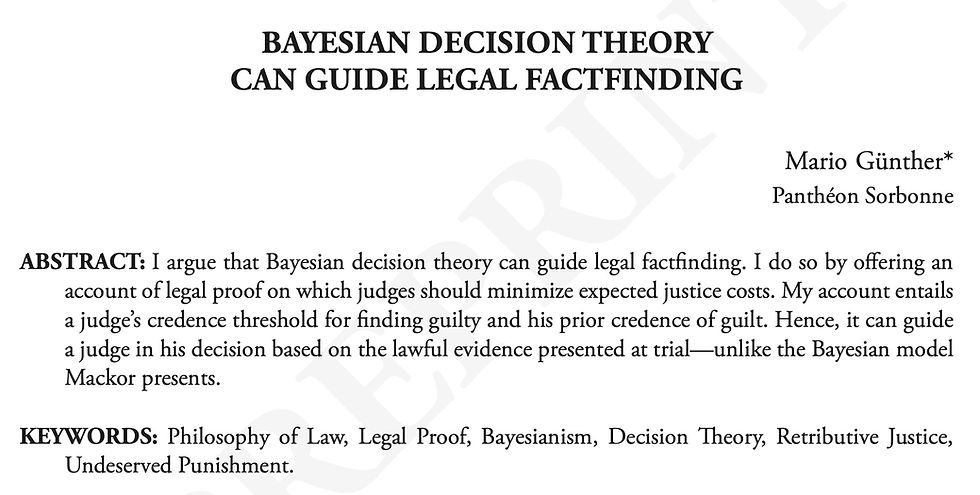
When should the lawful evidence presented to a judge become proof? This paper argues that Bayesian decision theory can answer that question—not by reducing legal judgment to arithmetic, but by making explicit what is at stake when courts risk punishing the innocent or letting the guilty go free. Its central idea is this: judges should minimize expected justice costs. From that single thought, the paper derives a probability threshold for conviction, a principled prior probability of guilt, and a measure of how strong the lawful evidence must be before guilt may be found. The result is a Bayesian account of legal proof that takes the presumption of innocence seriously while still giving judges real guidance in hard criminal cases. The paper is available Open Access in Quaestio Facti here.


Comments